
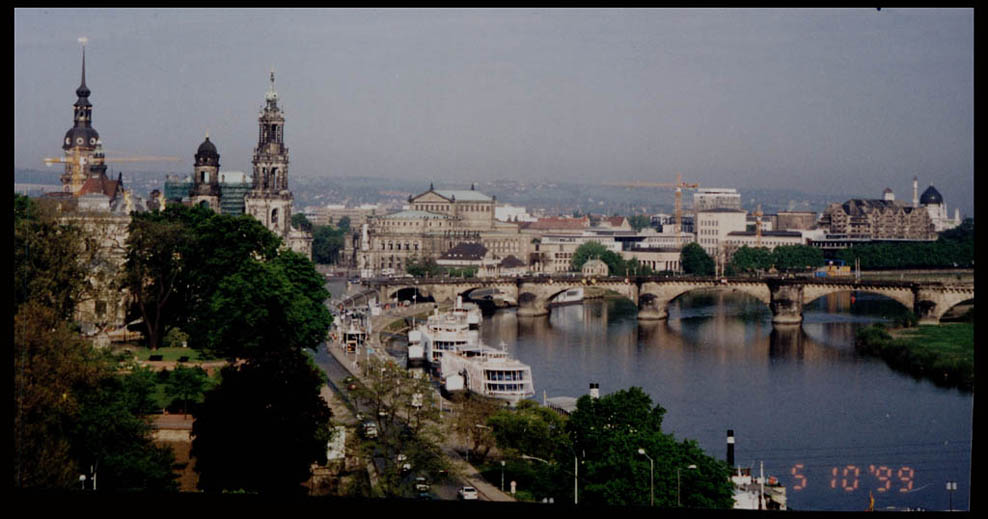

I am the north in this equation and Dresden is the East.
As we drove from Weimar to Dresden the concept of Eastern Germany took on a sharper outline. Germany has never existed for me in terms of East and West, it has just been Germany. Of course, I was five when the wall came down, and I don't think my generation (I am speaking in Canadian terms) has ever felt, or properly understood the threat of communism like our parents did. Perhaps a better way to say it is that communism seems very distant, and, as such, is totally foreign to us. What I have learned after my time in Dresden is that though Germany is unified in name, the reality is that the country is still defined by these two terms East and West.
Yesterday in Berlin an old friend of my Dad's good friend Frank who was kindly taking us to lunch said something quite extraordinary to me. "The war (WWII) didn't really end in this country until 1989." I had not quite thought about it in those terms, but certainly I felt closer to WWII in Dresden and Berlin than I ever had reading books or studying history. The effects of the War are everywhere in this country, from the mental scars of Soviet occupation, to the physical scars still evident in the geography. So much of East Germany has only recently been cleaned up after the buildings ruined in the war were left untouched until re-unification. Driving into Dresden we saw abandoned buildings with trees growing out of 2nd story windows, walls pockmarked with bullet holes, and countless edifices covered with banners showing pictures of what the building will look like when its restoration is complete. Dresden is a city of cranes, and building zones, and empty spaces.
With the surge of building and rebuilding has come amazing innovation. Dad, D and I had lunch at Volkswagen's "Transparent Factory" where you can eat and watch cars being assembled in a factory that looks like it came out of the space age. All of the floors are made of wood, and the walls of glass. Workers wear white lab coats and often gloves. The cars are hung from a conveyor belt in the ceiling that moves each vehicle along to the next station. It was totally fascinating. But, that was Dresden all over, a city of opposites, so deeply rooted in history and yet so committed to a vision of a brighter future.

2 comments:
What sort of food do they serve at a car factory?
Very good food! That was my best meal in Germany, although the service was unbelievably bad! You can't win them all.
Post a Comment